
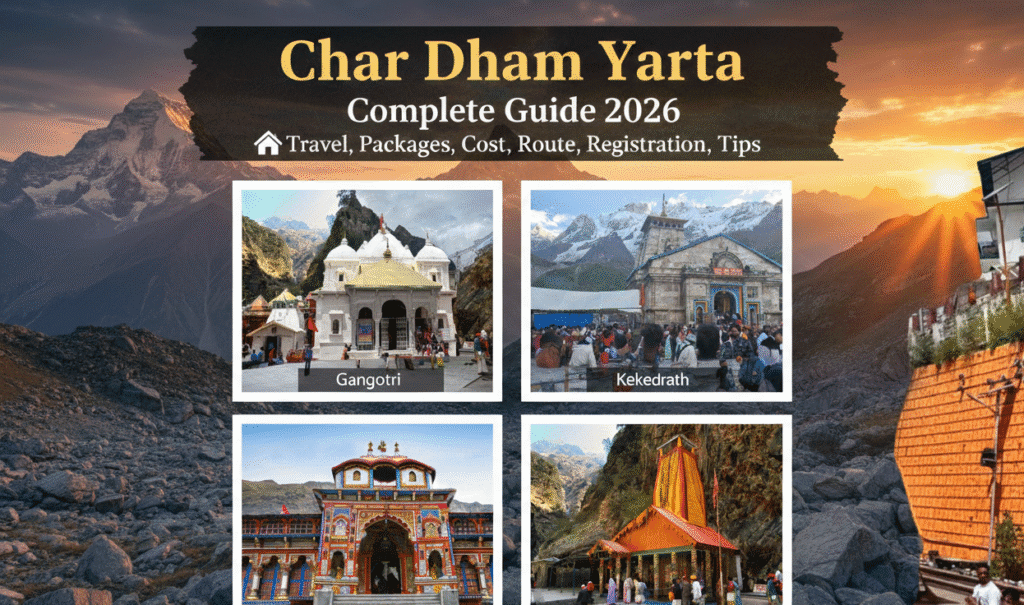
Char Dham Yatra Complete Guide 2026 (Travel, Packages, Cost, Route, Registration, Tips)
Char Dham Yatra is one of the most sacred Hindu pilgrimages in India. Every year, lakhs of devotees visit Yamunotri, Gangotri, Kedarnath, and Badrinath to seek blessings and spiritual purification.
In 2026, travelling to the Char Dham is becoming easier with improved roads, helicopter services, and online registration systems. However, planning properly is still very important for a smooth and safe journey.
This guide covers everything — route map, cost, best time, packages, registration, travel tips, and latest updates.
What is Char Dham Yatra?
Char Dham Yatra is a spiritual journey covering four holy temples in Uttarakhand:
- Yamunotri — Source of the Yamuna River
- Gangotri — Source of the Ganga River
- Kedarnath — Lord Shiva Jyotirlinga
- Badrinath — Lord Vishnu Temple
The journey usually follows this order: The Spiritual Logic
1: Yamunotri (The Origin)
- Symbolism: Dedicated to Goddess Yamuna.
- The Ritual: Yamuna is the sister of Yamraj (God of Death). Visiting here first is believed to remove the fear of death and cleanse the karmic slate.
2: Gangotri (The Purification)
- Symbolism: Dedicated to Goddess Ganga, who descended to earth to wash away the sins of humanity.
- The Ritual: After addressing the “fear of death” at Yamunotri, the devotee bathes in the Bhagirathi to achieve inner purity. You are now “clean” enough to enter the abode of the Gods (Shiva and Vishnu).
3: Kedarnath (The Tapasya/Penance)
- Symbolism: The seat of Lord Shiva.
- The Ritual: By trekking through the rugged Mandakini valley, the devotee sheds their ego and physical comforts, seeking the blessing of the “Destroyer of Ignorance.”
4: Badrinath (The Moksha/Salvation)
- Symbolism: The seat of Lord Vishnu (The Preserver).
- The Ritual: This is the final destination of chardham. In the calm, meditative atmosphere of Badrinath, the devotee seeks Moksha.
Why Char Dham Yatra is Important Spiritually
The Washing of Sins (Paap Mukti)
- The Power of Snana (Holy Bath): Taking a dip in the freezing waters of the Yamuna at Yamunotri and the Bhagirathi at Gangotri is believed to cleanse the Sanchita Karma (accumulated past sins).
- Ritual Purification: Pilgrims believe that the physical hardship of the journey acts as a form of penance (Prayashchitta), where the discomfort of the cold and the climb burns away spiritual impurities.
Achieving Moksha (The Ultimate Liberation)
- The Gateway to Heaven: Legend says that the Pandavas took this very route to ascend to the heavens. By following in their footsteps, devotees believe they are securing a place in the divine realm.
- The Vaikuntha Connection: Badrinath is often called Badrinath Dham, one of the four cardinal points of India established by Adi Shankaracharya. Visiting this “Earthly Vaikuntha” (home of Vishnu) is considered the final seal on a soul’s journey toward salvation.
- Strengthening Spiritual Energy (Shakti and Bhakti)
- Spiritual Vibration: These temples are built on high-energy zones where sages and saints have meditated for thousands of years. Being in the presence of the Jyotirlinga at Kedarnath is said to “recharge” the soul’s internal battery, heightening one’s intuition and mental peace.
- Testing Faith: The physical exertion required to reach these heights is seen as a test of Bhakti (devotion).
- Connection with Ancient Himalayan Temples
- Living Mythology: At these sites, the stories of the Mahabharata and Ramayana feel real. You are standing at the spot where King Bhagirath meditated.
- Architectural Marvels: Most of these temples, particularly Kedarnath, are architectural wonders built with massive stone slabs without the use of modern mortar.
Char Dham Yatra Opening Dates 2026 (Expected)
The opening of the Char Dham Kapat is determined by the Hindu Panchang (astrological calendar) and specific festivals. While the dates for 2026 are widely anticipated, they are formally announced on holy days like Maha Shivratri and Basant Panchami.
Here are the confirmed and expected dates for the 2026 pilgrimage season:
Char Dham Opening Dates 2026
Temple Opening Date (2026) Significance / Day
Yamunotri April 19, 2026 Akshaya Tritiya (Confirmed)
Gangotri April 19, 2026 Akshaya Tritiya (Confirmed)
Kedarnath, April 22, 2026, Announced on Maha Shivratri
Badrinath April 24, 2026 Announced on Basant Panchami
Best Time for Char Dham Yatra
Here is the month-by-month strategic breakdown for 2026:
- The Peak Season: May – June
- Pros: Most stable weather for helicopter services; all facilities (shops, ponies, medical camps) are fully operational.
- Cons: Extreme Crowds. Expect 4–6 hour wait times for Darshan. Prices for private taxis and hotels are at their highest.
- 2026 Tip: If you travel in the first 10 days of May (just after the opening), carry heavy woollens as temperatures at Kedarnath will still hover around 0°C to 5°C.
- The Danger Zone: July – August (Monsoon)
- The Risk: Landslides are frequent on the Rishikesh-Badrinath highway. The 18km Kedarnath trek becomes slippery and dangerous.
- The Reality: Many seasoned pilgrims choose this time for the “Peaceful Darshan” because crowds are at their lowest. However, helicopter services are often suspended due to low visibility.
- 2026 Warning: Only choose this if you have a flexible schedule (3-4 buffer days) in case of road closures.
- The “Golden Window”: September – October
- Why it’s Best: The massive summer rush has subsided. You get the best mountain views
- Weather: Daytime is pleasant (10°C to 15°C), but nights start getting very cold.
- 2026 Strategy: Target the last two weeks of September. It’s the “sweet spot” where the monsoon has ended, but the extreme winter chill hasn’t yet arrived
- Late Season: November
The temples usually close within the first week of November (around Bhai Dooj).
- Experience: It is bone-chillingly cold. Many shops and guesthouses start packing up.
- Benefit: You can witness the emotional Closing Ceremony where the deities are moved to their winter abodes in Ukhimath and Joshimath.
Final Expert Verdict for 2026: If you are travelling with senior citizens, choose late May. If you are a photographer or seeking peace, choose late September
Char Dham Yatra Route Map
Char Dham Yatra ka route ek ‘Parikrama’ ki tarah hota hai jo hamesha west (pashchim) se east (poora) ki taraf badhta hai. 2026 mein road connectivity pehle se kaafi behtar ho gayi hai, lekin pahaadi raaston ki wajah se stops ko samajhna bahut zaroori hai.
Yahan iske har पड़ाव ki puri jankari di gayi hai:
- Main Starting Points (Aagman)
- Haridwar: Sabse lokpriya point. Yahan ‘Har ki Pauri’ mein Ganga Aarti karke yatra shuru karna shubh mana jata hai.
- Rishikesh: Yoga aur dhyan ka kendra. Rishikesh se hi asli pahadi rasta shuru hota hai.
- Dehradun: Agar aap Flight se aa rahe hain (Jolly Grant Airport), toh yeh sabse nazdeek padega.
- Pehla Dham: Yamunotri (Barkot Base)
- Route: Haridwar/Rishikesh → Mussoorie → Barkot.
- Detailing: Barkot ek khubsurat hill station hai jahan se Yamunotri ki yatra plan ki jati hai. Barkot se aap Janki Chatti tak gaadi se jate hain, phir wahan se 6 km ka trek karke Yamunotri Mandir pahunchte hain.
- Key Stop: Hanuman Chatti aur Surya Kund.
- Dusra Dham: Gangotri (Uttarkashi Base)
- Route: Barkot → Dharasu Band → Uttarkashi → Gangotri.
- Detailing: Uttarkashi ko ‘Kashi of North’ kaha jata hai. Yahan Vishwanath mandir ke darshan hote hain. Uttarkashi se Gangotri tak ka rasta lagbhag 100 km hai jo Bhagirathi nadi ke kinare-kinare chalta hai.
- Key Stop: Harsil Valley (is raste ka sabse sundar gaon).
- Tisra Dham: Kedarnath (Guptkashi/Sonprayag Base)
- Route: Uttarkashi → Srinagar (Garhwal) → Rudraprayag → Guptkashi/Phata/Sonprayag.
- Detailing: Yeh yatra ka sabse kathin hissa hai. Sonprayag tak gaadi jati hai, uske baad Gaurikund tak shuttle. Gaurikund se 18 km ka trek shuru hota hai Kedarnath ke liye.
- Key Stop: Rudraprayag (Alaknanda aur Mandakini nadi ka sangam).
- Chautha Dham: Badrinath (Joshimath Base)
- Route: Kedarnath → Guptkashi → Chopta → Joshimath → Badrinath.
- Detailing: Kedarnath se neeche aakar aap Chopta (Mini Switzerland) hote huye Joshimath pahunchte hain. Joshimath se Badrinath ka rasta lagbhag 45 km hai.
- Key Stop: Mana Village (Bharat ka aakhiri gaon) aur Tapt Kund.
- Wapsi (Return Journey)
- Route: Badrinath → Joshimath → Karnaprayag → Nandprayag → Rishikesh → Haridwar.
- Detailing: Wapsi ke raste mein aap Panch Prayag (panch pavitra sangam) ke darshan karte huye neeche aate hain.
Char Dham Yatra Route Map
For 2026, while the All-Weather Road project has made the journey smoother, the total distance remains a significant test of endurance.
Here is the exact breakdown of the distance you will cover by road and on foot.
- Overall Distance Summary
- Total Journey (from Haridwar/Rishikesh): ~1,100 – 1,250 KM
- Total Journey (from Delhi): ~1,600 – 1,800 KM
- Total Trekking Distance: ~44 – 50 KM (Round trip for Yamunotri and Kedarnath)
- Segment-wise Distance Chart (Road)
Following the traditional clockwise route, here are the approximate driving distances:
Route Segment Approx. Distance Approx. Driving Time
Haridwar → Barkot 220 KM 7 – 8 Hours
Barkot → Janki Chatti 45 KM 2 Hours
Barkot → Uttarkashi 90 KM 4 Hours
Uttarkashi → Gangotri 100 KM 4 – 5 Hours
Uttarkashi → Guptkashi 210 KM 8 – 9 Hours
Guptkashi → Sonprayag 30 KM 1.5 Hours
Guptkashi → Badrinath 190 KM 7 – 8 Hours
Badrinath → Rishikesh 290 KM 10 – 11 Hours
- Trekking Distance
Yamunotri Trek (From Janki Chatti)
- Distance: 6 KM (One way) | 12 KM (Round trip)
- Time: 3–5 hours uphill.
- Difficulty: Moderate. The path is narrow but concrete.
Kedarnath Trek (From Gaurikund)
- Distance: 16 – 18 KM (One way) | 32 – 36 KM (Round trip)
- Time: 6–10 hours uphill.
- Difficulty: High. This is the toughest part of the Yatra. The “New Route” after the 2013 floods is longer but safer, featuring better gradients and medical points.
- 2026 Distance Updates
- Helicopter Shortcut: If you take a helicopter for Kedarnath (from Phata, Sersi, or Guptkashi), you skip the 32 KM trek entirely, reducing your physical exertion by 70%.
- Road Widening: Thanks to the Chardham Mahamarg Pariyojana, many 8-hour drives are now being completed in 6 hours.
Chardham Detailed Opening Rituals & Traditions
- Yamunotri & Gangotri
Both temples traditionally open on the auspicious day of Akshaya Tritiya.
- The Procession: One day before the opening, the idol of Goddess Ganga is brought from her winter home in Mukhba village, and Goddess Yamuna is brought from Khushimath (Kharsali).
- Why April 19? Akshaya Tritiya is considered the “day of unending luck.” Starting the Yatra on this day is believed to multiply the spiritual merits of the pilgrim.
- Kedarnath
The opening date for Kedarnath is calculated by the priests at Omkareshwar Temple in Ukhimath.
- The Announcement: It is traditionally declared on the day of Maha Shivratri (February 15, 2026).
- The Doli Yatra: Lord Shiva’s Panchmukhi Doli (palanquin) travels from Ukhimath to Kedarnath over three days, reaching the shrine just before the doors open at dawn (usually around 7:00 AM).
- Badrinath
The Badrinath-Kedarnath Temple Committee (BKTC) announces this date during the festival of Basant Panchami.
- Royal Tradition: The date is finalized based on the astrological charts of the Tehri Royal Family.
- The Opening: It usually opens 2–3 days after Kedarnath. The first darshan of the season is called the Maha Abhishek, which is a visual treat for early arrivals.
2026 Closing Dates (Expected)
While opening dates are celebrated with joy, closing dates are determined by the onset of heavy winter snow.
- Gangotri: November 1, 2026 (usually on the day of Diwali).
- Yamunotri & Kedarnath: November 3, 2026 (on the day of Bhai Dooj).
- Badrinath: Mid-November 2026 (The exact date is announced on Vijayadashami/Dussehra).
Char Dham Yatra Package Cost 2026
In 2026, the Char Dham Yatra cost is influenced by the All-Weather Road convenience and high-demand Helicopter services. While the spiritual experience is priceless, a clear budget helps manage the 10-12-day journey.
Here is the realistic price breakdown for the 2026 season:
- Budget Package (For Groups & Solo Travelers)
- Cost: ₹14,500 – ₹25,000 per person.
- Transport: Shared Non-AC Bus or Tempo Traveler (Seater).
- Stay: Guesthouses, GMVN (Government) dormitories, or basic lodges.
- Meals: Simple vegetarian thali (Breakfast + Dinner).
- Best for: Students, solo pilgrims, and those who prioritise the ritual over comfort.
- Standard Package (The Family Choice)
- Cost: ₹30,000 – ₹55,000 per person.
- Transport: Private AC Car (Sedan/SUV like Swift Dzire or Ertiga) for a group of 4.
- Stay: 2-star or 3-star equivalent hotels with attached washrooms.
- Meals: Buffet Breakfast and Dinner.
- Inclusions: Driver allowance, fuel, tolls, and parking.
- Best for: Families and small groups looking for a balanced, private experience.
- Luxury Package (Premium Pilgrimage)
- Cost: ₹70,000 – ₹1,25,000 per person.
- Transport: Premium SUV (Toyota Innova Crysta) with an experienced hill driver.
- Stay: Best available boutique resorts or luxury cottages (e.g., Sarovar Portico in Badrinath).
- Service: VIP Darshan passes, on-call support, guided local sightseeing, and oxygen kits in the vehicle.
- Best for: Senior citizens or those who want maximum comfort and minimal logistical hassle.
- Helicopter Package (Ex-Dehradun)
- Cost: ₹1,90,000 – ₹2,45,000 per person (All-inclusive).
- Duration: 5 Nights / 6 Days.
- Inclusions:
o VIP Darshan at all temples (saves 15-20 hours of queuing).
o Stay in premium hotels and all meals.
o Palki/Pony services at Yamunotri.
- Best for: High-priority travellers, those with health restrictions, or anyone with limited time.
Hidden Costs to Budget For:
Even with a “fixed” package, keep these additional expenses in mind:
- Pony / Palki at Kedarnath: ₹2,500 – ₹8,000 (depending on demand).
- Kedarnath Heli Shuttle (if not in package): ₹8,800 – ₹12,500 (Round trip).
- Special Poojas: Personal Abhishek or Aarti bookings can cost between ₹2,500 and ₹15,000 per family.
- GST: Most packages will add 5% GST on top of the quoted price.
Char Dham Registration 2026
In 2026, the Uttarakhand government tightened the Registration process to ensure pilgrim safety and crowd management. It is 100% mandatory and free of cost. You will be stopped at check-posts like Sonprayag and Janki Chatti if you do not have your Yatra Registration Letter (QR Code).
Quick Registration Details
Feature Information
Official Website – registrationandtouristcare.uk.gov.in
WhatsApp Registration – Send “Yatra” to +91-8394833833
Mobile App – “Tourist Care Uttarakhand” (Android/iOS)
Toll-Free Helpline – 1364 (or 0135-1364 for other states)
Required Documents
- Photo ID: Aadhaar Card (preferred), Voter ID, Passport, or Driving License.
- Mobile Number: Must be active to receive an OTP for verification.
- Passport Size Photo: A clear selfie taken on your phone is sufficient for online registration.
Steps to Register Online (5 Minutes)
- Create Account: Visit the portal, click “Register/Login,” and enter your mobile number.
- Add Tour Info: Click “Create/Manage Tour Info” and select your travel dates and the specific Dhams you plan to visit.
- Add Pilgrims: Enter the name, age, and ID details of everyone travelling with you.
- Upload Documents: Upload a photo of your ID and a selfie.
- Download QR Code: Once submitted, download the Yatra Registration Letter. Keep a digital copy on your phone and print one for backup.
Important for 2026
- Daily Caps: The government may enforce daily limits (e.g., 13,000 for Kedarnath). Register at least 15–30 days in advance to secure your preferred dates.
- Physical Verification: At the shrines, officials will scan your QR code. This is also called “Biometric Verification.”
- Medical Declaration: You must honestly fill out a health declaration form during registration, especially if you have BP, asthma, or heart conditions.
Char Dham Yatra Safety Tips
Safety is the top priority for the Uttarakhand government in 2026. With the Himalayas being geologically “young” and fragile, being a smart traveler means respecting the terrain.
Here is the essential safety protocol for your 2026 pilgrimage:
- Real-Time Weather & Route Monitoring
Himalayan weather can change from clear blue skies to a heavy downpour in under 20 minutes.
- The “Tourist Care” App: In 2026, it is highly recommended to keep the Tourist Care Uttarakhand app’s notifications ON. The government sends real-time SMS alerts about weather changes or road blockages.
- Respect the “Gates”: If police or SDRF (Special Disaster Response Force) officials stop traffic at checkpoints like Vyasi or Joshimath due to weather, do not argue. These stops are for your safety.
- Buffer Days: Always keep 2 buffer days in your 2026 itinerary. If a landslide occurs, it can take 12–24 hours for the Border Roads Organisation (BRO) to clear the path.
- Road Safety: The “No Night Driving” Rule
Driving on mountain roads is vastly different from the plains.
- Strict Timings: In 2026, driving on hill routes between 8:00 PM and 5:00 AM is strictly prohibited for commercial vehicles and highly discouraged for private ones.
- Hire Local Experts: If you are not used to “Hairpin Bends” and steep gradients, do not drive yourself. Local “Pahadi” drivers are trained to handle the specific mechanics of engine braking and narrow passes.
- The “Hill Endorsement”: If hiring a private taxi, ensure the driver’s license has a “Hill Endorsement” stamp. This is a mandatory safety requirement in Uttarakhand.
- Choosing a Trusted Travel Agency
With the rise in spiritual tourism, 2026 has seen a spike in “ghost” travel agencies.
- Verify Registration: Check if the agency is registered with the Uttarakhand Tourism Development Board (UTDB).
- Avoid “Too Good to be True” Deals: If a package for the full Char Dham is priced under ₹15,000, it likely compromises on vehicle safety or hotel hygiene.
- Check Vehicle “Green Card”: Every commercial vehicle entering the Yatra circuit must have a Green Card—a document proving the vehicle is mechanically fit for high-altitude travel.
- Trekking Safety (Kedarnath & Yamunotri)
- Never Trek Alone: Even on the well-paved 18km Kedarnath route, stay with your group or within sight of other pilgrims.
- The “Upward” Rule: On narrow paths, always stay on the hillside (inner side) and give way to ponies or palkis coming from behind. Never stand on the valley-side edge.
- Flashlights: If you start your trek at 3:00 AM (to reach for morning Aarti), carry a powerful LED torch or headlamp. Path lighting can sometimes fail due to rain.
2026 Emergency Contact List
Service Number
Emergency Helpline 112
Ambulance Service 108
Tourism Helpline 1364
Disaster Management 0135-2710334
Frequently Asked Questions
To wrap up your 2026 planning, here are the answers to the most common questions pilgrims ask before hitting the road.
- Is Char Dham Yatra safe?
Yes, it is safer than ever. In 2026, the All-Weather Road project had significantly reduced the narrow, “scary” sections of the highway.
- Safety Net: The Uttarakhand government now has SDRF (Disaster Response) teams stationed every few kilometres.
- The Caveat: It is only “safe” if you respect the mountains. Avoid July and August (monsoon) when landslides are a real threat. Always check the “Tourist Care Uttarakhand” app for weather alerts before starting your day’s drive.
- How many days are needed?
- By Road (Full Circuit): 10 to 12 Days is the standard. This allows for acclimatization and buffer time for weather delays.
- By Road (Do Dham – Kedarnath & Badrinath): 5 to 7 Days.
- By Helicopter (Full Circuit): 5 to 6 Days (usually starting from Dehradun).
- Can kids travel?
Yes, children above 5 years can usually handle the Yatra well.
- Health Check: Consult a pediatrician first. Kids can sometimes struggle with “Ear Barotrauma” (ear pain) due to rapid altitude changes during the drive.
- The Trek: For the 18 km Kedarnath trek, it is highly recommended to hire a Pony or Palki for children to avoid exhaustion.
- Essentials: Carry plenty of snacks (biscuits, chocolates), a thermos for warm water, and double the layers of clothing you would carry for an adult.
Quick FAQ Summary Table
Question Answer
Is a Medical Certificate required? Recommended for those 55+ or with pre-existing conditions.
Can I drive my own car? Yes, but only if you are experienced in steep hill driving.
Is there a mobile network? Jio and Airtel work well in most towns, but expect “no signal” on the trekking paths.
Are ATM machines available? Yes, in major towns like Uttarkashi and Joshimath, but carry sufficient cash as machines often run out during peak season.
Final Checklist for a Blessed Journey
To ensure your 2026 Yatra is truly life-changing, keep these final takeaways in mind:
- Respect the “Mobile-Free” Zones: As of 2026, mobile phones and cameras are strictly banned inside the temple complexes (beyond the Singhdwar in Badrinath and Kedarnath) to maintain spiritual sanctity.
- Embrace the Digital QR System: Your 2026 registration is linked to a unique QR code. Keep it handy (digital and printed) for seamless verification at entry points like Sonprayag and Janki Chatti.
- Timing is Key: Aim for late April/May to witness the majestic opening ceremonies or late September for the clearest Himalayan views.
- Listen to the Mountains: Always follow the instructions of the SDRF and temple authorities. If a weather alert is issued via the Tourist Care app, treat it as a divine sign to rest and reflect.
2026 Key Dates Recap
Temple Opening Date Closing Date (Expected)
Yamunotri April 19, 2026 Nov 3, 2026
Gangotri April 19, 2026 Nov 1, 2026
Kedarnath April 22, 2026 Nov 3, 2026
Badrinath April 24, 2026 Mid-November 2026
The Himalayas do not just test your strength; they offer a perspective that stays with you long after you return to the plains. May your journey be filled with peace, health, and profound discovery.